Tell us about the job
Takes about a minute. No obligation.
A contractor quoting a central AC repair in Cheshire County starts with a question that does not come up in most counties: whether the system has ever really run at all. Homes in Cheshire County, NH have essentially no cooling season — no month of the year is warm enough to call for it. A compressor that sits idle season after season corrodes at the electrical contacts, the capacitor dries out, and the refrigerant circuit can develop small leaks that go undetected for years because nothing triggers a service call. When a homeowner does call, it is usually the first hot stretch anyone can remember, and the fault has been sitting there long enough to look like sudden failure. A contractor has to separate a part that wore out from a part that simply waited too long.
Ductwork laid down for an earlier generation of equipment carries wear that a visual inspection at the register will not show. Half the homes in Cheshire County, New Hampshire were built in 1972 or earlier (2020-2024 ACS 5-year). That means when a central AC system fails and a contractor opens it, the repair question often extends past the unit itself: a section of duct that has been pulling air through a seam gap, or insulation that has compressed past the point of doing its job, can account for what the homeowner was calling a cooling problem. The part that failed may be straightforward to source. What surrounds it is not always in the same condition.
The Parts of a Central AC a Contractor Checks First
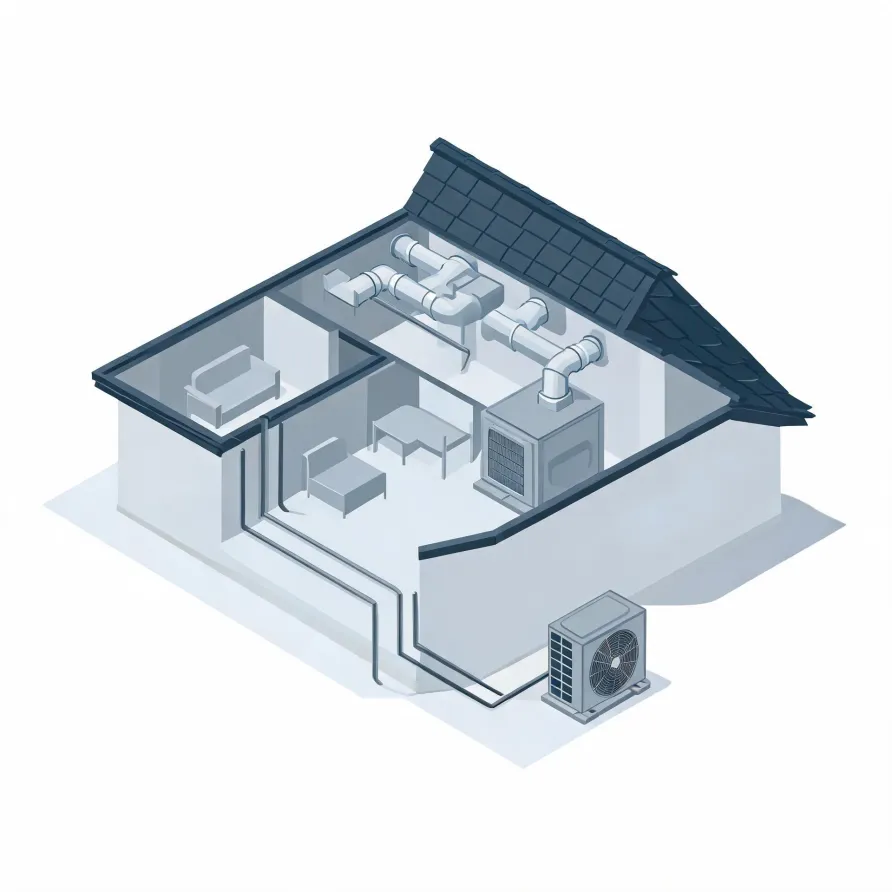
The outdoor condenser unit sits outside the house, usually on a concrete pad at ground level, and it is where heat gets shed to the outside air. The compressor lives inside that cabinet and is one of the first things a contractor examines when the system stops cooling. A failed capacitor, a seized compressor, or a refrigerant leak will all show up here.
Inside the house, the air handler or furnace cabinet holds the evaporator coil, which is where the system pulls heat out of your indoor air. The coil, the blower motor, and the refrigerant lines that run between the two units each carry their own failure points, and a contractor works through all of them when tracing a cooling problem.
The drawing shows the general layout of a central AC system, and a licensed contractor determines what applies to your specific house and equipment.
Find a contractor in Cheshire CountyCheshire County, by the numbers
247 severe weather events were recorded in Cheshire County, New Hampshire between 2015 and 2024.
NOAA National Centers for Environmental Information, Storm Events Database, bulk CSV export, events 2015-01-01 through 2024-12-31.Half the homes in Cheshire County, New Hampshire were built in 1972 or earlier (2020-2024 ACS 5-year).
U.S. Census Bureau, 2020-2024 American Community Survey 5-Year EstimatesCheshire County, New Hampshire holds 35,899 housing units (2020-2024 ACS 5-year).
U.S. Census Bureau, 2020-2024 American Community Survey 5-Year EstimatesOwners occupy 72.7% of the occupied homes in Cheshire County, New Hampshire (2020-2024 ACS 5-year).
U.S. Census Bureau, 2020-2024 American Community Survey 5-Year EstimatesCodes & Standards Governing Central AC Repair in Cheshire County, New Hampshire10 sourced rules and standards
What HVAC Repair Looks Like in Cheshire County
Split-system central air conditioners rated below 45,000 Btu/h manufactured on or after January 1, 2023 must meet a federal minimum of 13.4 SEER2.
Split-system central air conditioners rated at or above 45,000 Btu/h manufactured on or after January 1, 2023 must meet a federal minimum of 13.4 SEER2.
Split-system central air conditioners manufactured between January 1, 2015 and December 31, 2022 had to meet 13 SEER, the metric that preceded SEER2.
Single-package central air conditioners manufactured on or after January 1, 2023 must meet a federal minimum of 13.4 SEER2.
Space-constrained central air conditioners manufactured on or after January 1, 2023 must meet a federal minimum of 11.7 SEER2.
Federal efficiency standards for split-system central air conditioners and heat pumps are set on each certified combination of outdoor unit and indoor coil rather than on the outdoor unit alone.
Residential and light commercial air conditioning and heat pump systems assembled in the field, including mini-splits and unitary systems, may not be installed on or after January 1, 2025 using a refrigerant with a global warming potential above 700.
A field-assembled system whose specified components were all manufactured or imported before January 1, 2025 carries no installation compliance date under the refrigerant restrictions and may still be installed.
Rules That Apply to HVAC Repair Work in Cheshire County, New Hampshire
New Hampshire's mechanical licensing board issues nine credentials — hearth system, four fuel gas endorsements, domestic appliance technician, and master, journeyman and apprentice plumber — and a licensee may not work outside the specialty their licence names. None of the nine is an HVAC licence.
New Hampshire does not license HVAC as a trade, and says so where it matters: the plumbing licence expressly does not reach a person installing heating, cooling, air conditioning or domestic water heating systems, whether solar, oil, gas or electric. The gas piping on a gas-fired system is a separate matter and needs a fuel gas fitter licence.
Severe Weather Events in Cheshire County
Extreme weather puts real stress on central AC systems, from hard starts after power outages to sustained runtime during prolonged heat. What happens in Cheshire County shapes how hard that equipment works and how often it needs attention.
247 severe weather events, 2015–2024. Source: NOAA National Centers for Environmental Information, Storm Events Database.