Tell us about the job
Takes about a minute. No obligation.
A contractor quoting central AC in Sullivan County has to size the system for a climate that barely calls on it. Homes in Sullivan County, NH have essentially no cooling season — no month of the year is warm enough to call for it. A compressor that sits idle nearly every month of the year does not wear out from cycling. It corrodes, it seizes, and refrigerant migrates through seals that never get worked. When a system here finally does fail, the cause is almost never runtime. A poor original install or a unit that has simply sat too long will account for it, and a contractor scoping the job checks those things first.
Ductwork in much of Sullivan County's housing stock was sized for whatever the house originally ran, and a new central AC system moves air on different terms. Half the homes in Sullivan County, New Hampshire were built in 1974 or earlier (2020-2024 ACS 5-year). That gap between what the ducts were built for and what a contractor is now connecting to them is where installation work gets complicated or stays simple. If the existing trunk lines and branch runs carry the new load, the job moves quickly. If they do not, a contractor has to open walls or ceilings before the unit itself ever gets set.
What a Central AC System Looks Like Before Installation
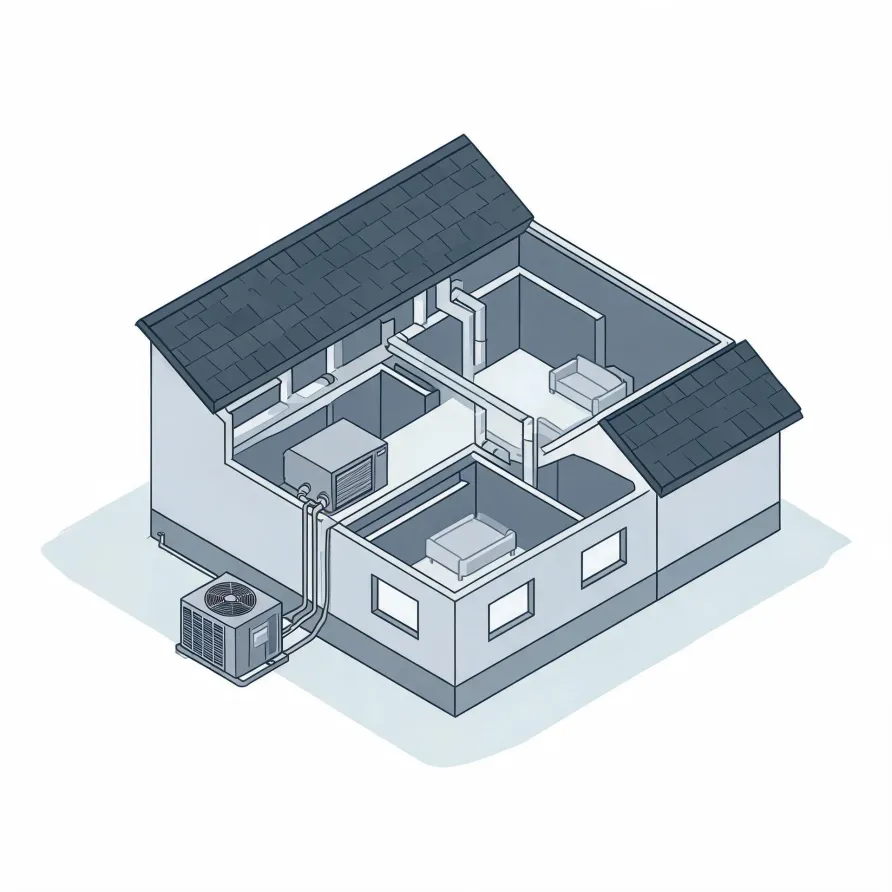
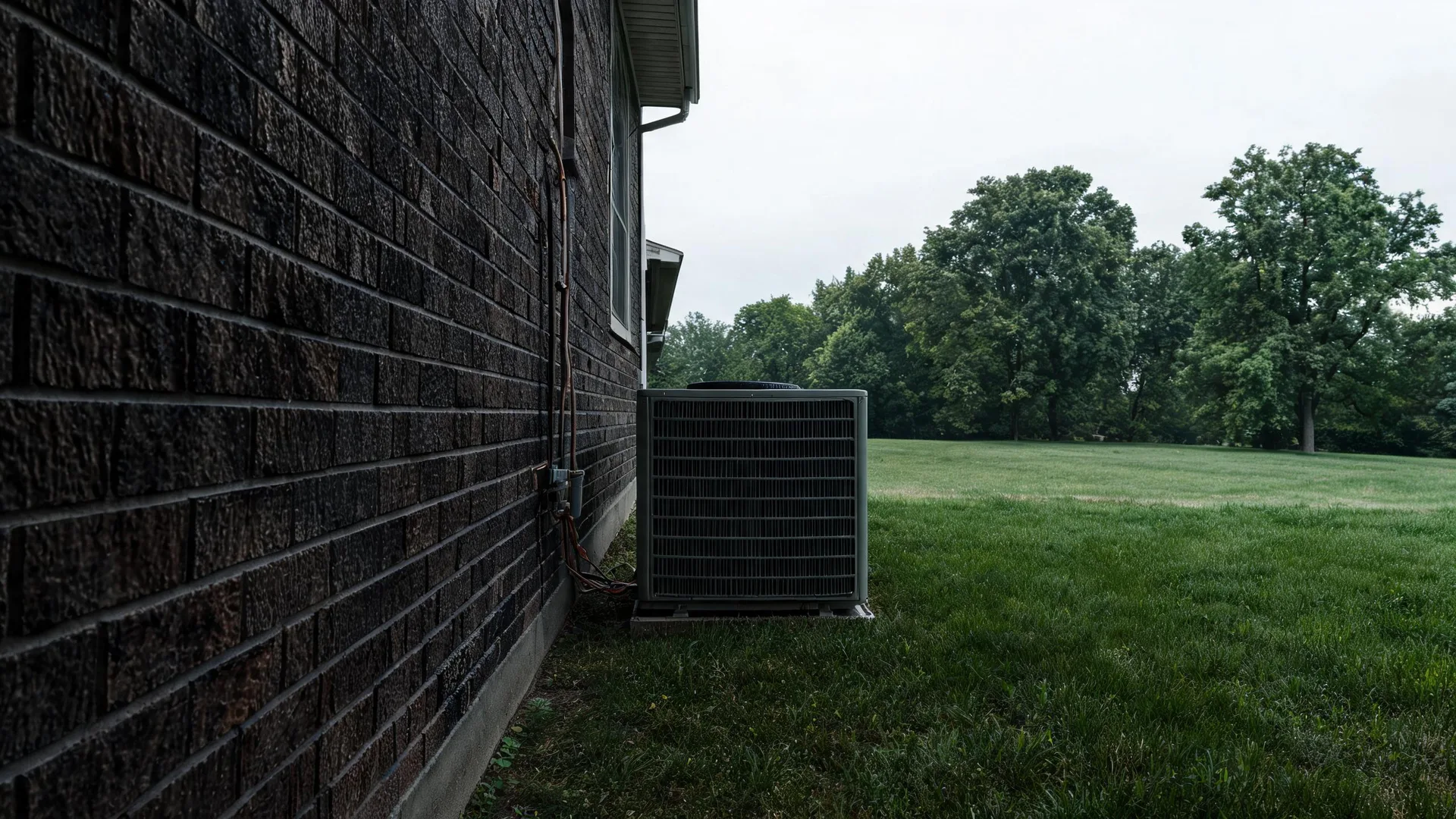
The outdoor condenser unit sits on a concrete pad beside the house and holds the compressor and condenser coil. Inside, the air handler mounts in a utility space, basement, or closet and contains the evaporator coil and blower that push conditioned air through the home.
A refrigerant line set runs between the two units, carrying refrigerant through copper tubing that connects the indoor and outdoor sides. A condensate drain line exits the air handler and directs moisture out of the system, and a thermostat mounts on an interior wall where it reads the indoor temperature and signals the system to run.
The drawing shows a typical layout, and a licensed contractor determines what the configuration looks like for this particular house.
Find a contractor in Sullivan CountySullivan County, NH, by the numbers
111 severe weather events were recorded in Sullivan County, New Hampshire between 2015 and 2024.
NOAA National Centers for Environmental Information, Storm Events Database, bulk CSV export, events 2015-01-01 through 2024-12-31.Half the homes in Sullivan County, New Hampshire were built in 1974 or earlier (2020-2024 ACS 5-year).
U.S. Census Bureau, 2020-2024 American Community Survey 5-Year EstimatesSullivan County, New Hampshire holds 21,958 housing units (2020-2024 ACS 5-year).
U.S. Census Bureau, 2020-2024 American Community Survey 5-Year EstimatesOwners occupy 75.4% of the occupied homes in Sullivan County, New Hampshire (2020-2024 ACS 5-year).
U.S. Census Bureau, 2020-2024 American Community Survey 5-Year EstimatesCodes & Standards for Central AC Installation in Sullivan County, New Hampshire10 sourced rules and standards
What the installation actually looks like
Split-system central air conditioners rated below 45,000 Btu/h manufactured on or after January 1, 2023 must meet a federal minimum of 13.4 SEER2.
Split-system central air conditioners rated at or above 45,000 Btu/h manufactured on or after January 1, 2023 must meet a federal minimum of 13.4 SEER2.
Split-system central air conditioners manufactured between January 1, 2015 and December 31, 2022 had to meet 13 SEER, the metric that preceded SEER2.
Single-package central air conditioners manufactured on or after January 1, 2023 must meet a federal minimum of 13.4 SEER2.
Space-constrained central air conditioners manufactured on or after January 1, 2023 must meet a federal minimum of 11.7 SEER2.
Federal efficiency standards for split-system central air conditioners and heat pumps are set on each certified combination of outdoor unit and indoor coil rather than on the outdoor unit alone.
Residential and light commercial air conditioning and heat pump systems assembled in the field, including mini-splits and unitary systems, may not be installed on or after January 1, 2025 using a refrigerant with a global warming potential above 700.
A field-assembled system whose specified components were all manufactured or imported before January 1, 2025 carries no installation compliance date under the refrigerant restrictions and may still be installed.
What Sullivan County and New Hampshire Require for HVAC Installation
New Hampshire's mechanical licensing board issues nine credentials — hearth system, four fuel gas endorsements, domestic appliance technician, and master, journeyman and apprentice plumber — and a licensee may not work outside the specialty their licence names. None of the nine is an HVAC licence.
New Hampshire does not license HVAC as a trade, and says so where it matters: the plumbing licence expressly does not reach a person installing heating, cooling, air conditioning or domestic water heating systems, whether solar, oil, gas or electric. The gas piping on a gas-fired system is a separate matter and needs a fuel gas fitter licence.
Severe Weather Events in Sullivan County
The load a cooling system carries depends on what the local climate actually does to a building. Weather stress in Sullivan County shapes how hard equipment works and how quickly that wear accumulates, which is why the installation decisions here are not the same as they would be somewhere else.
111 severe weather events, 2015–2024. Source: NOAA National Centers for Environmental Information, Storm Events Database.