Tell us about the job
Takes about a minute. No obligation.
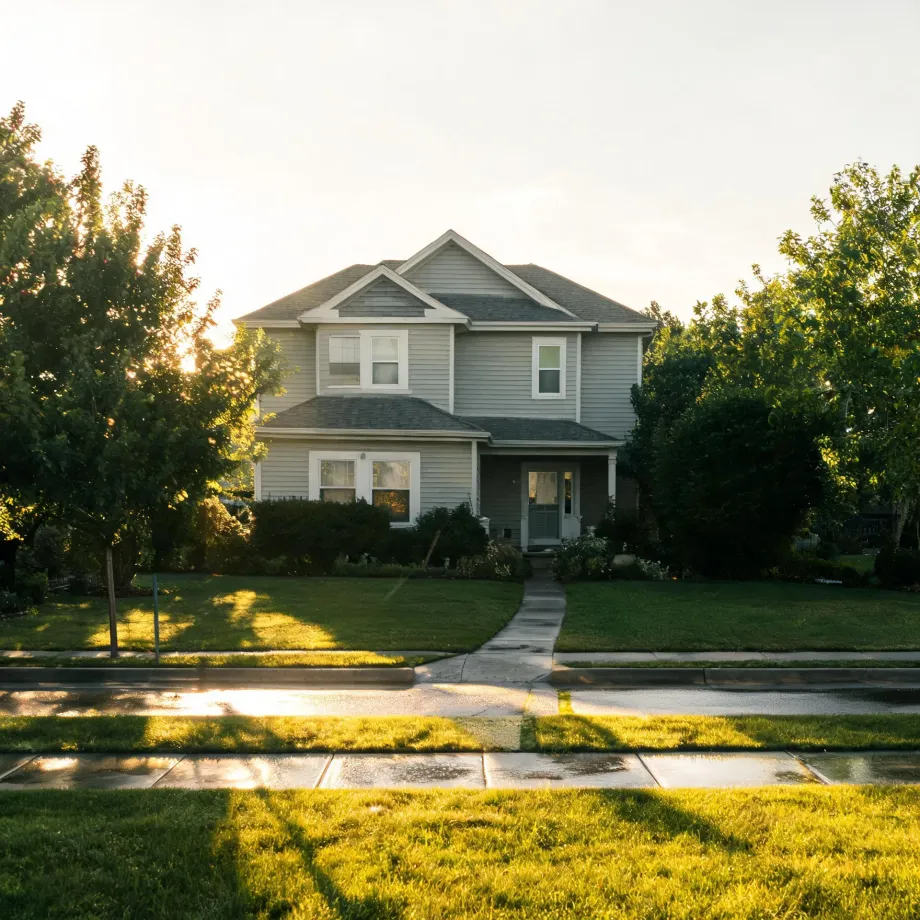
Sizing a central AC system for a house in Merrimack County is not a task a contractor can afford to rough out. Homes in Merrimack County, NH run cooling in a single month of the year, July. The compressor runs only in that narrow window, so an undersized unit has almost no opportunity to show signs of strain before the season ends and the system sits cold again. A fault can stay hidden until the following July, when the homeowner calls on the first hot day and the compressor is already struggling. Getting the load calculation right before the equipment goes in is what determines whether the system keeps up when it actually matters.
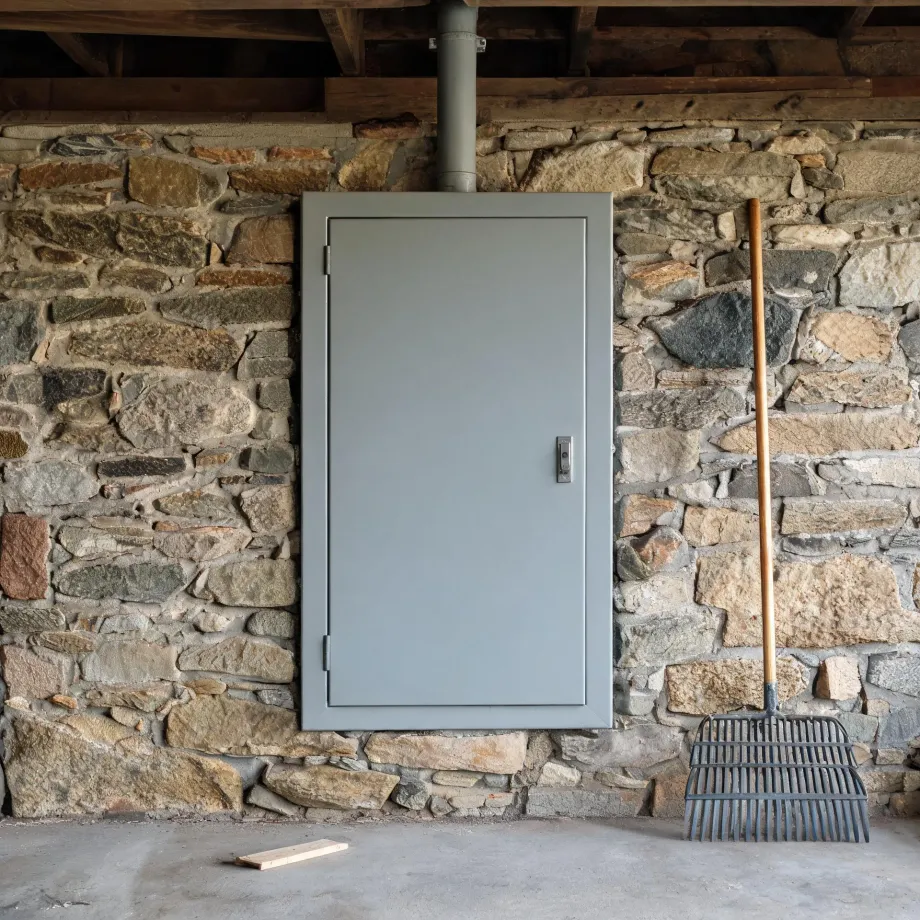
Ductwork laid down for one generation of equipment does not automatically serve the next. Half the homes in Merrimack County, New Hampshire were built in 1977 or earlier (2020-2024 ACS 5-year). That depth of housing stock means a meaningful share of homes here have trunks and returns that were sized for systems with different airflow demands than what a contractor is now hanging. Electrical service runs a close second: panels in houses of that era were not configured for the loads a modern central AC unit draws. A contractor quoting a new system in Merrimack County prices the ductwork and the electrical before the unit itself, because those two variables are where the job either goes straight or gets complicated.
What a Central AC System Is Made Of
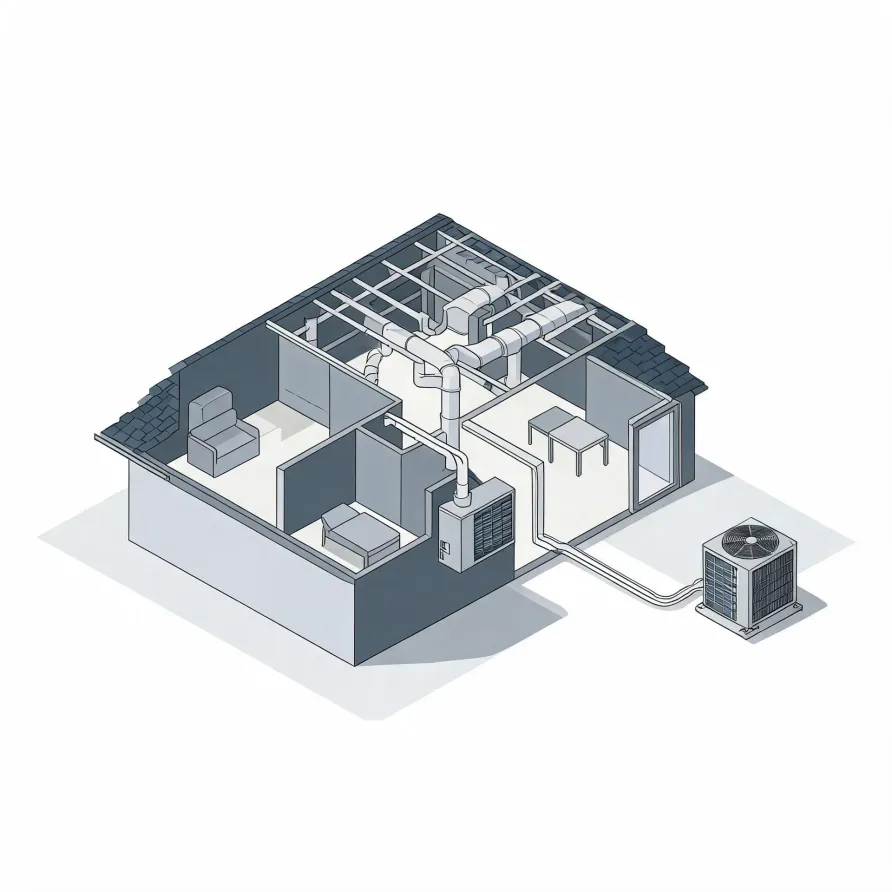
The outdoor unit sits on a concrete pad beside the house and holds the compressor and condenser coil, which together shed heat collected from inside. The indoor air handler mounts in a utility space, basement, or attic and contains the evaporator coil and blower fan that pull warm air across the coil and push conditioned air into the supply ducts.
A refrigerant line set runs between the two units, carrying refrigerant back and forth through insulated copper tubing. The thermostat mounts on an interior wall and acts as the control point for the whole system, telling the air handler and outdoor unit when to run.
The drawing shows a representative layout, and a licensed contractor determines exactly how each piece applies to your home.
Find a contractor in Merrimack CountyMerrimack County by the numbers
138 severe weather events were recorded in Merrimack County, New Hampshire between 2015 and 2024.
NOAA National Centers for Environmental Information, Storm Events Database, bulk CSV export, events 2015-01-01 through 2024-12-31.Half the homes in Merrimack County, New Hampshire were built in 1977 or earlier (2020-2024 ACS 5-year).
U.S. Census Bureau, 2020-2024 American Community Survey 5-Year EstimatesMerrimack County, New Hampshire holds 66,497 housing units (2020-2024 ACS 5-year).
U.S. Census Bureau, 2020-2024 American Community Survey 5-Year EstimatesOwners occupy 73.5% of the occupied homes in Merrimack County, New Hampshire (2020-2024 ACS 5-year).
U.S. Census Bureau, 2020-2024 American Community Survey 5-Year EstimatesCodes & Standards Governing Central AC Installation in Merrimack County, New Hampshire10 sourced rules and standards
What happens when the contractor shows up
Split-system central air conditioners rated below 45,000 Btu/h manufactured on or after January 1, 2023 must meet a federal minimum of 13.4 SEER2.
Split-system central air conditioners rated at or above 45,000 Btu/h manufactured on or after January 1, 2023 must meet a federal minimum of 13.4 SEER2.
Split-system central air conditioners manufactured between January 1, 2015 and December 31, 2022 had to meet 13 SEER, the metric that preceded SEER2.
Single-package central air conditioners manufactured on or after January 1, 2023 must meet a federal minimum of 13.4 SEER2.
Space-constrained central air conditioners manufactured on or after January 1, 2023 must meet a federal minimum of 11.7 SEER2.
Federal efficiency standards for split-system central air conditioners and heat pumps are set on each certified combination of outdoor unit and indoor coil rather than on the outdoor unit alone.
Residential and light commercial air conditioning and heat pump systems assembled in the field, including mini-splits and unitary systems, may not be installed on or after January 1, 2025 using a refrigerant with a global warming potential above 700.
A field-assembled system whose specified components were all manufactured or imported before January 1, 2025 carries no installation compliance date under the refrigerant restrictions and may still be installed.
What Merrimack County and New Hampshire Require for HVAC Installation
New Hampshire's mechanical licensing board issues nine credentials — hearth system, four fuel gas endorsements, domestic appliance technician, and master, journeyman and apprentice plumber — and a licensee may not work outside the specialty their licence names. None of the nine is an HVAC licence.
New Hampshire does not license HVAC as a trade, and says so where it matters: the plumbing licence expressly does not reach a person installing heating, cooling, air conditioning or domestic water heating systems, whether solar, oil, gas or electric. The gas piping on a gas-fired system is a separate matter and needs a fuel gas fitter licence.
Severe Weather Events in Merrimack County
Weather in Merrimack County puts real demands on cooling equipment, and those demands shape what a proper installation needs to handle. A system sized and installed for local conditions will run differently than one that was not.
138 severe weather events, 2015–2024. Source: NOAA National Centers for Environmental Information, Storm Events Database.