Tell us about the job
Takes about a minute. No obligation.
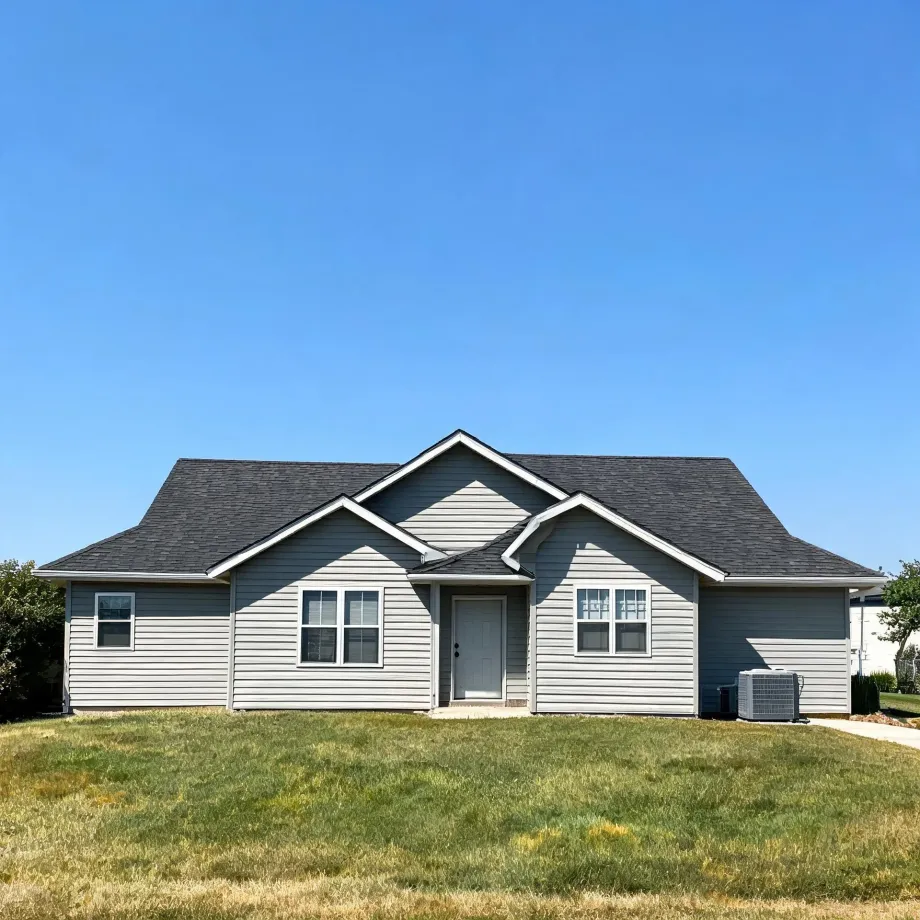
Sizing a central AC system correctly in Strafford County depends on what the compressor actually faces each year. Homes in Strafford County, NH run cooling in a single month of the year, July. The compressor, condenser fan, and contactor spend most of the year off, then start cold when summer arrives. A system that was undersized or installed without a proper load calculation shows it on those first hard days, when every other homeowner is calling too. A contractor quoting a new installation here has to account for that short, concentrated demand rather than specifying equipment for steady seasonal use.
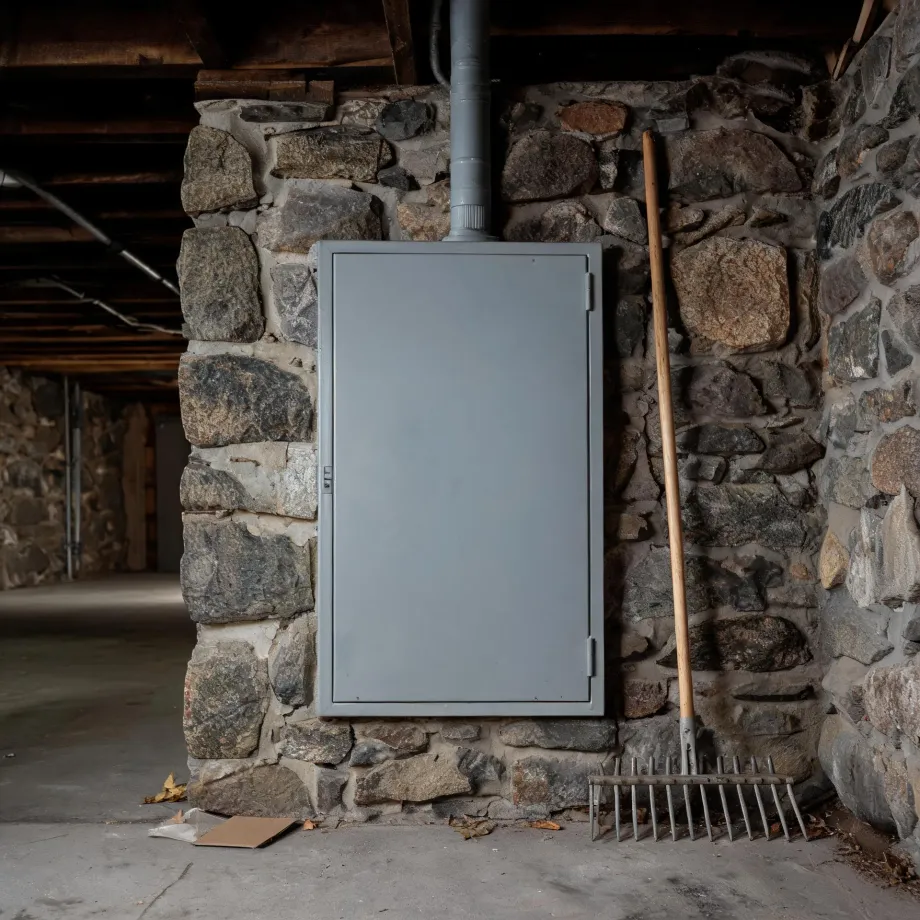
Ductwork laid out for a furnace and a different era of equipment does not automatically carry a central AC system without adjustment. Half the homes in Strafford County, New Hampshire were built in 1979 or earlier (2020-2024 ACS 5-year). That history shows up when a contractor opens the plenum and checks what the trunk lines actually deliver to each room, because a cooling load distributes air differently than the heating system the ducts were built around. If the ductwork cannot move the volume a new unit requires, the electrical panel becomes secondary. The duct assessment is where the installation budget gets set.
What a Central AC System Includes
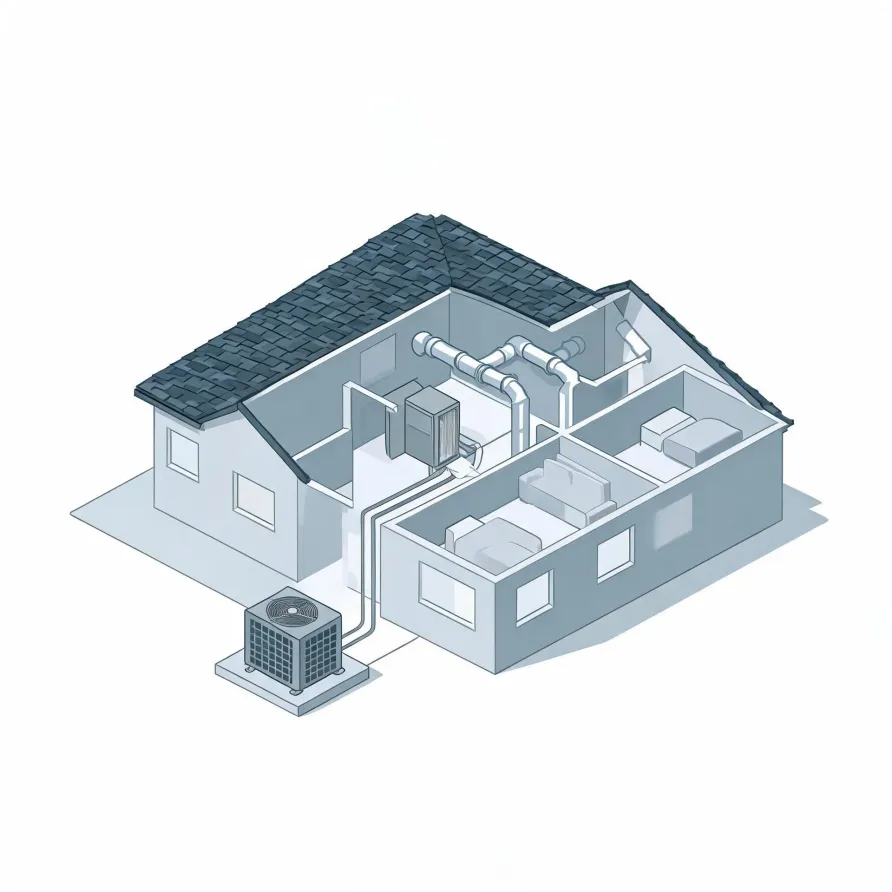
The outdoor condenser unit sits on a pad beside the house and holds the compressor and condenser coil, the components that do the heaviest work in the system. Inside, the air handler or furnace with its evaporator coil lives in a utility room, basement, or attic, and this is where the cooled air enters the home's airstream.
The refrigerant line set runs between the two units, carrying refrigerant back and forth through insulated copper tubing that passes through the wall or floor. The thermostat mounts on an interior wall and gives the homeowner control over when the system runs and what temperature it holds.
The drawing shows the general layout of a central AC system, and a licensed contractor determines exactly what applies to this house.
Find a contractor in Strafford CountyStrafford County, by the numbers
97 severe weather events were recorded in Strafford County, New Hampshire between 2015 and 2024.
NOAA National Centers for Environmental Information, Storm Events Database, bulk CSV export, events 2015-01-01 through 2024-12-31.Half the homes in Strafford County, New Hampshire were built in 1979 or earlier (2020-2024 ACS 5-year).
U.S. Census Bureau, 2020-2024 American Community Survey 5-Year EstimatesStrafford County, New Hampshire holds 56,609 housing units (2020-2024 ACS 5-year).
U.S. Census Bureau, 2020-2024 American Community Survey 5-Year EstimatesOwners occupy 67.1% of the occupied homes in Strafford County, New Hampshire (2020-2024 ACS 5-year).
U.S. Census Bureau, 2020-2024 American Community Survey 5-Year EstimatesCodes & Standards for Central AC Installation in Strafford County, New Hampshire10 sourced rules and standards
What the installation actually looks like
Split-system central air conditioners rated below 45,000 Btu/h manufactured on or after January 1, 2023 must meet a federal minimum of 13.4 SEER2.
Split-system central air conditioners rated at or above 45,000 Btu/h manufactured on or after January 1, 2023 must meet a federal minimum of 13.4 SEER2.
Split-system central air conditioners manufactured between January 1, 2015 and December 31, 2022 had to meet 13 SEER, the metric that preceded SEER2.
Single-package central air conditioners manufactured on or after January 1, 2023 must meet a federal minimum of 13.4 SEER2.
Space-constrained central air conditioners manufactured on or after January 1, 2023 must meet a federal minimum of 11.7 SEER2.
Federal efficiency standards for split-system central air conditioners and heat pumps are set on each certified combination of outdoor unit and indoor coil rather than on the outdoor unit alone.
Residential and light commercial air conditioning and heat pump systems assembled in the field, including mini-splits and unitary systems, may not be installed on or after January 1, 2025 using a refrigerant with a global warming potential above 700.
A field-assembled system whose specified components were all manufactured or imported before January 1, 2025 carries no installation compliance date under the refrigerant restrictions and may still be installed.
Licensing and Legal Requirements in Strafford County, New Hampshire
New Hampshire's mechanical licensing board issues nine credentials — hearth system, four fuel gas endorsements, domestic appliance technician, and master, journeyman and apprentice plumber — and a licensee may not work outside the specialty their licence names. None of the nine is an HVAC licence.
New Hampshire does not license HVAC as a trade, and says so where it matters: the plumbing licence expressly does not reach a person installing heating, cooling, air conditioning or domestic water heating systems, whether solar, oil, gas or electric. The gas piping on a gas-fired system is a separate matter and needs a fuel gas fitter licence.
Severe Weather Events in Strafford County
Strafford County weather puts real cumulative stress on cooling equipment, and that stress shapes what a well-sized, properly installed system needs to handle. What contractors spec and install here is a local decision, and local conditions are part of that calculation.
97 severe weather events, 2015–2024. Source: NOAA National Centers for Environmental Information, Storm Events Database.